
The $6.3 Billion Lesson: What the Binance Hack Teaches Every Business
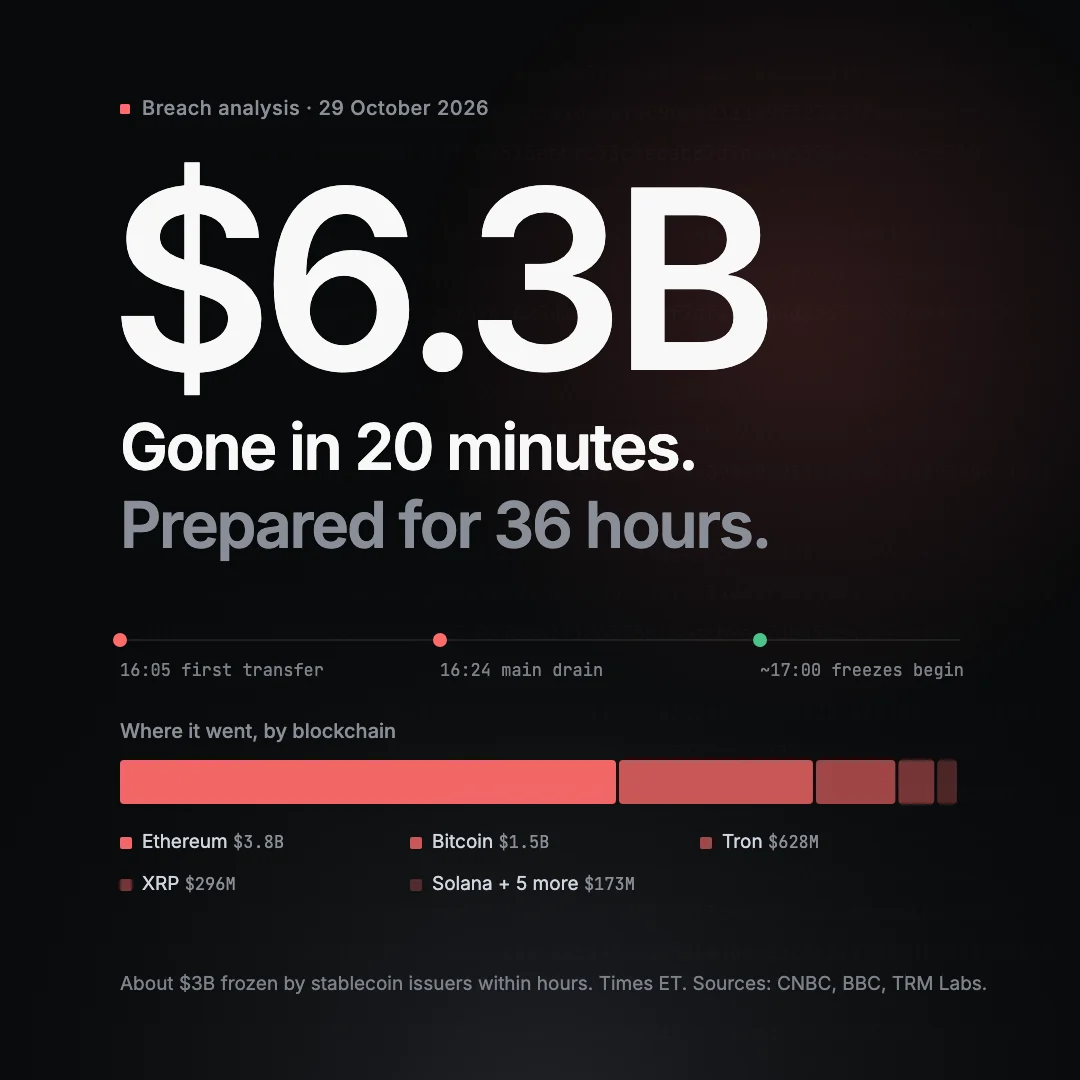
On the afternoon of 29 October, attackers drained around $6.3 billion in digital assets from Binance, the world's largest cryptocurrency exchange. The main theft took about 20 minutes and hit ten different blockchains. It is the largest crypto heist on record, more than four times the $1.5 billion taken from Bybit in 2025, and the FBI has since said North Korea was behind it.
You probably don't run a crypto exchange. But the way this attack worked, and the way it was partly contained, holds lessons for every business that keeps money, data or customer trust online. Which is every business.
What happened
The full story is still coming out, but here is what has been reported so far:
- It started with one person. Binance's early explanation pointed to a single compromised laptop belonging to a software engineer, which was then used to make unauthorised withdrawals from the exchange's "hot wallet", the pool of funds kept online for day-to-day transactions. Binance has since said other issues were also involved.
- The attackers were patient. Investigators believe the attack was prepared at least 36 hours in advance.
- Then they were fast. Once they moved, billions left in minutes, across Ethereum, Bitcoin, Tron, XRP, Solana and more.
- The response saved half of it. Stablecoin issuers Tether and Circle began freezing wallets within an hour. Around $3 billion was frozen. The Bitcoin, worth about $1.5 billion, could not be.
- Binance can absorb it. Most companies couldn't. The exchange says it will cover customers' losses from its reserve and insurance funds, and restored backing for about 90% of affected assets within two days.
That last point matters most. Binance has billions in reserves. For a small or mid-size business, a breach a fraction of this size is the kind of event that ends the company.
Lesson 1: Your biggest risk is one person's device or account
Binance spends heavily on security, and the attackers still got in, reportedly through one engineer's laptop. That's how most breaches start, at any scale: a phishing email, a reused password, a malicious download, a fake job offer.
What to do: Turn on multi-factor authentication everywhere, and use phishing-resistant methods such as passkeys or security keys for the accounts that matter most: email, banking, cloud admin and your domain registrar. Keep laptops patched and protected with endpoint security. Train staff to recognise the approaches that actually get used.
Lesson 2: Attackers prepare before they strike
A 20-minute theft that took 36 hours or more to set up. Attackers rarely smash and grab. They get in, look around, find what's valuable and wait for the right moment.
What to do: Make sure someone would notice an unfamiliar login, a new admin account or a mailbox forwarding rule before the money moves. Even simple alerts from Microsoft 365 or Google Workspace, if someone actually reads them, shorten that window.
Lesson 3: No single key should open everything
Whatever the exact route turns out to be, one compromised foothold led to control over billions. The less any single person, laptop or password can do on its own, the less an attacker gets from stealing it.
What to do: Give people only the access they need. Require a second person to approve large payments and changes to bank details, the same defence that stops most business email compromise fraud. Separate admin accounts from everyday ones.
Lesson 4: Speed of response decides how bad it gets
Roughly half the stolen funds were frozen because partners acted within the hour. Speed came from relationships and procedures that were already in place.
What to do: Write down, today, who you call when something goes wrong: your bank's fraud line, your IT provider, your cyber insurer and a security firm. Know how to lock accounts and stop payments quickly. A one-page incident plan you've read beats a perfect one you haven't written.
Lesson 5: You can't absorb what Binance absorbed
Binance had a reserve fund large enough to cover billions. You almost certainly don't, and that's the strongest argument there is for treating security as indispensable rather than optional. Prevention costs a fraction of recovery, and recovery is only possible if you're still in business.
What to do: Check whether your cyber insurance actually covers fraud and incident response, and what the insurer expects from you in return. Many now ask about MFA, backups and how you manage vulnerabilities before they'll pay.
Start with what attackers can already see
Attackers this sophisticated are rare. The habits they exploit are not. Most attacks on smaller businesses begin with something visible from the outside: a domain that can be spoofed for a convincing phishing email, a forgotten subdomain, an exposed admin page or file.
VortexByte Exposure checks those things for free and explains every fix in plain English. It takes a few minutes and shows you what an attacker would see first.
And if you want to know how far a determined attacker could get through one compromised laptop, that's exactly what our penetration testing and red team work is for. Talk to us.